
If you’re sourcing forged wheels for your business or guiding customers on their custom builds, you’ve probably come across terms like 1‑piece, 2‑piece, and 3‑piece wheels. While they might sound like just engineering terms, the difference between them can significantly impact cost, performance, maintenance, and fitment options.
This article breaks things down clearly — no jargon, no sales pitch — just practical insights so you can make the right decisions for your clients and inventory.
What’s the Difference Between 1‑Piece, 2‑Piece, and 3‑Piece Wheels?
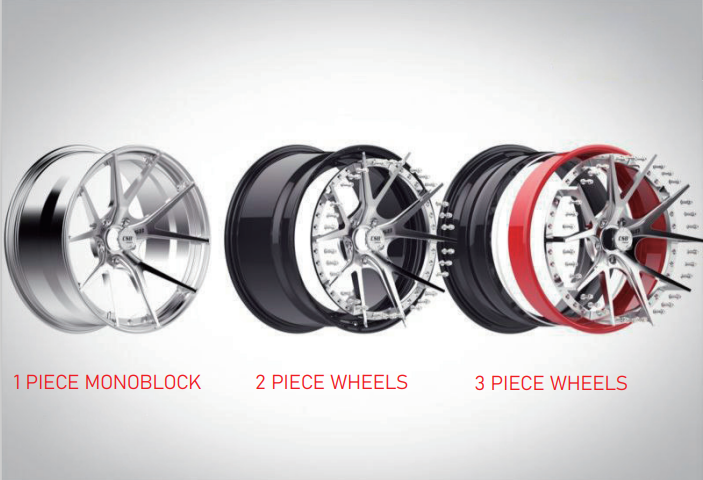
- 1‑Piece Wheel: Forged from a single solid block of aluminum. There are no joints or bolts; everything — centre, barrel, lip — is machined from one billet and formed as one integrated piece.
- 2‑Piece Wheel: Made from two separate parts — usually a centre disc and an outer barrel or lip — joined together by welding or bolting.
- 3‑Piece Wheel: Built from three components — centre, outer lip, and inner barrel — all bolted together with sealing hardware and usually a silicone seal to make them airtight.
Key Comparisons That Matter
1. Strength & Durability
- 1‑Piece: Offers the highest structural integrity because there are no seams or joints. It’s the strongest option under most conditions.
- 2‑Piece & 3‑Piece: Still very strong, especially when forged, but the joints and bolts introduce potential stress points. They require precision assembly to maintain long-term reliability.
Verdict: For high-stress or racing applications, 1‑piece forged wheels are often preferred for their consistency and resilience.
2. Weight
- 1‑Piece: Typically the lightest, since there’s no additional hardware or overlapping material.
- 2‑Piece & 3‑Piece: Slightly heavier due to fasteners, thicker flanges, and sealing systems — though differences may be marginal depending on size and design.
Verdict: When lightweight performance is critical, like in motorsports or EVs, 1‑piece forged wheels have the edge.
3. Customization & Fitment Flexibility
- 1‑Piece: Offers limited flexibility. Once the wheel is forged, the width, offset, and lip design are fixed. Customization is restricted to the original design.
- 2‑Piece: Offers more flexibility in adjusting offset and width by combining different centre and barrel dimensions.
- 3‑Piece: The most customizable of all. You can choose exact lip depth, barrel width, bolt pattern, and face design. Even after purchase, the setup can be reconfigured.
Verdict: If your clients need extreme offsets, wide stances, or frequent fitment changes, multi‑piece wheels are the better choice.
4. Repairability & Maintenance
- 1‑Piece: Damage to the lip or barrel usually means replacing the entire wheel.
- 2‑Piece: Some parts can be replaced, depending on design. Welded types are harder to service.
- 3‑Piece: Highly serviceable — you can replace just the damaged part (lip or barrel) instead of the entire wheel.
Verdict: For customers who race, off-road, or frequently change setups, 3‑piece wheels offer long-term value through repairability.
5. Cost
- 1‑Piece: Generally the most cost-effective forged option due to simpler production and fewer parts.
- 2‑Piece: Slightly more expensive due to additional machining and assembly labor.
- 3‑Piece: Highest cost — more parts, more time, more complexity.
Verdict: If budget matters and standard specs are sufficient, 1‑piece is the most economical. If clients are building high-end or extreme vehicles, the higher cost of 2‑ or 3‑piece wheels may be justified.
When to Use Each Type
| Application | Best Wheel Type | Why |
|---|---|---|
| OEM Replacement | 1‑Piece | Simple, strong, and cost-effective |
| Daily Driving + Mild Performance | 1‑Piece or 2‑Piece | Balance between value and performance |
| High-End Street Build | 2‑Piece | Custom fitment with strong aesthetics |
| Show Car or Widebody Setup | 3‑Piece | Extreme customization and visual impact |
| Track or Racing Use | 1‑Piece or 3‑Piece | Lightweight or replaceable parts depending on risk of damage |
| Off-Road or Deep Lip Truck Wheels | 3‑Piece | Large lips and extreme widths are easier to achieve |
What You Should Consider as a Buyer
- Know Your End User: Are they building a showpiece, a race car, or just looking for something that fits well and looks good?
- Match Specs to Needs: Don’t oversell a 3‑piece wheel to someone who just needs a basic performance upgrade.
- Factor in Logistics: Multi‑piece wheels may require more lead time, precision in shipping/assembly, and more detailed quality checks.
- Ask About Maintenance Tolerance: Not every customer wants to check bolts and seals regularly. Simpler may be better.
- Think Long-Term: If a client wants future flexibility (e.g., swapping lips/barrels later), a 3‑piece investment could make more sense now.
Final Thoughts
There’s no single answer to “which is better” — because it depends on who the wheel is for and what they’re trying to build.
If you’re stocking for general customers or tuning shops, 1‑piece forged wheels will cover most needs: strong, light, affordable, and simple. If your clients demand custom widths, aggressive fitments, or build cars for shows or media exposure, offer them 2‑piece or 3‑piece wheels — and make sure your supplier has tight quality control and strong support behind those builds.
The right wheel isn’t the one with the most parts — it’s the one that fits the vehicle, the budget, and the vision.