Manufacturing / Quality Control
Forged Wheel Quality Control: Inspected Twice, Signed Once
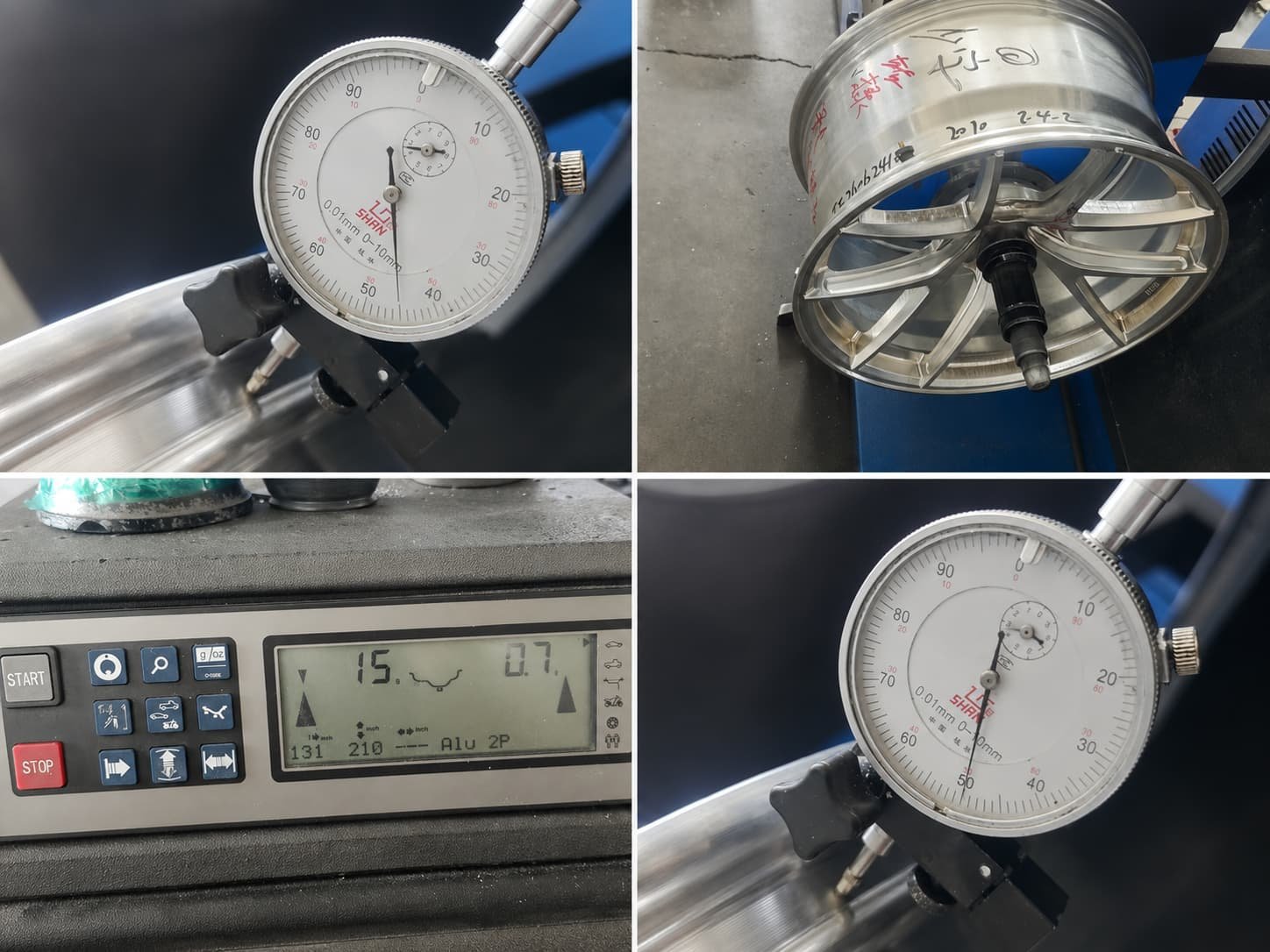
Quality control on a forged wheel is not an adjective — it is a record. Every part that goes into a FLEXIFORGED wheel is inspected twice: once by whoever made it, once by us. Every wheel is 100% runout tested to a 0.25 mm standard limit, engraved with a serial number, and shipped with a QC record you can ask to see. This page walks through the three inspection gates, the numbers behind them, and the four ways you can check all of it yourself.
- Designed & inspected in-house
- 60+ CNC at our group's plant
- ISO & IATF 16949 certified plant
- MOQ from 4 pcs
- Worldwide export
What does quality control include here?
Three inspection gates, placed where our supply chain actually needs them. We buy forged blanks, lips and barrels from specialists and machine at our group's plant — a structure we publish openly on the About page — and buying parts in only works under one operating assumption: the supplier is wrong until proven otherwise.
| Gate | What is inspected | By whom | When |
|---|---|---|---|
| 1 · Incoming | Every bought forged blank | FLEXIFORGED | Before it is cut — a defect found in a blank costs a blank; found after machining, it costs a wheel and a schedule |
| 2 · At the maker | Machined parts; bought lips and barrels | The plant that machined it; the supplier that formed it | Before the part leaves their floor |
| 3 · Second inspection | Every part, again — including 100% runout and key dimensions | FLEXIFORGED, in-house | Before assembly and packing |
Gate 2 catches the maker's process problems. Gate 3 catches everything else — and it exists because gate 2 belongs to someone else. Accountability for all three is ours: one name on the invoice, whichever gate a problem would have slipped through.
What are the tolerances and test figures?
These are the numbers behind the word "quality" — the same ones that appear on your drawing and in your QC record. If a figure is not in this table, we do not have it verified, and we would rather show you a gap than a guess.
| Parameter | Figure |
|---|---|
| Runout test coverage | 100% of wheels — every wheel, not a batch sample |
| Runout limit | 0.25 mm (0.010") radial and lateral as standard; for 2-piece and 3-piece builds the limit depends on construction and is set on your drawing |
| Key dimensions | ±0.05 mm |
| CNC material removal | ~0.02" per cut, spindle centred to ~0.001", at our group's plant |
| Material machined away, forged blank → finished wheel | Typically over 70% of the forged blank's weight on a monoblock; the exact share depends on design and size |
| Load rating | 690–1200 kg depending on vehicle and build — on the drawing and engraved on the wheel |
| Traceability | Engraved serial number + QC record per wheel; photos / video on request |
Why 100% and not a batch sample: a batch check is a statistical statement about the batch. It is also a bet that the four wheels you received were among the good ones. We would rather test all of them and not bet. For scale: alloy-wheel runout limits in OEM service manuals commonly sit around 0.7–0.76 mm.
The serial number: every wheel signs its own work
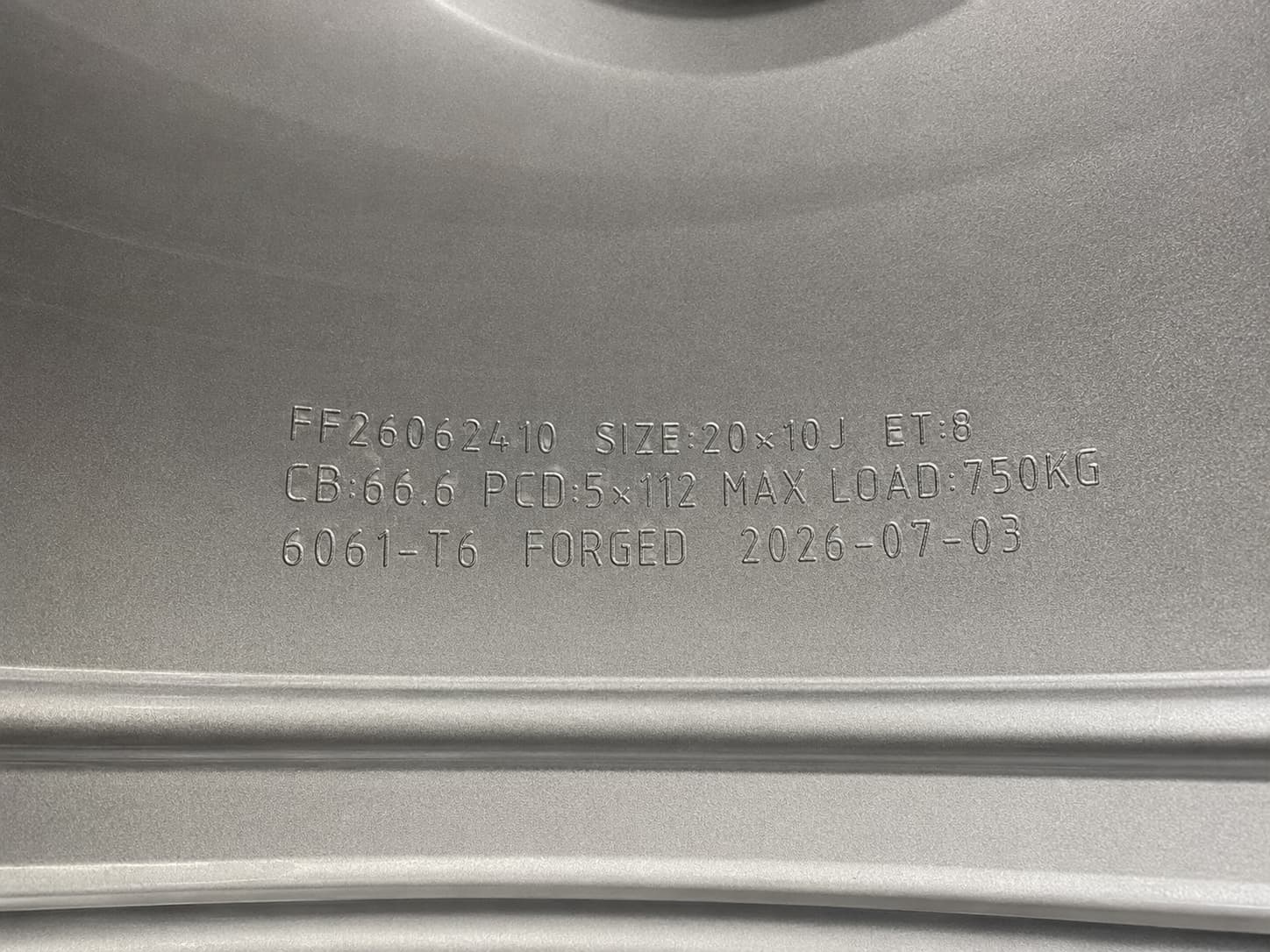
Each wheel is engraved with its own serial number, alongside its size, offset, centre bore and load rating. That serial ties the physical wheel to its QC record — so if a wheel is ever questioned, it traces back to a day and a machine, years after it left here.
On the wheel
Serial number · size · ET · CB · PCD · max load · alloy · production date, laser-marked on the inner barrel. Not a sticker that peels — a mark that outlives the finish.
In the record
The inspection results behind that serial — including runout and dynamic balance inspection — with photos or video of your actual wheels available on request. Not catalog shots.
The check we invite
Match the engraving on the wheel in your hand against the record we sent. They should agree. If they ever don't, that is our problem to fix, traceably.
Anonymity in this industry protects the supplier, not the buyer. A wheel that cannot be traced cannot be answered for — which is why the serial number is not an option on our wheels; it is the default. The same logic runs through bought components too: lips and barrels pass the same double inspection before they go into an assembly.
Certifications — and how to actually verify them
ISO and IATF 16949. Here is the precise version, because precision is the entire point of this page: the certificates are held by the plant that machines our wheels, not by FLEXIFORGED itself. That is how group structures work — and a brand that shows you a certificate image without mentioning whose name is printed in the header is hoping you do not read headers.
You will notice there are no certificate images on this page. That is deliberate: the certificates carry the plant's name, and we do not publish the plant's name — normal practice for a wheel brand. What we do instead is more useful than a badge graphic:
Copies on request
The certificates themselves, sent to you directly, together with an explanation of the plant's relationship to our group — so you see the whole picture, not a JPEG.
What IATF 16949 means
It is the automotive industry's quality management standard. Holding it means the process control was audited by a third party with no commercial interest in the answer — the difference between a plant that says it is careful and one that has been checked.
No product certification
No JWL, VIA or TÜV: every wheel is custom-engineered for one vehicle and one order. If your market requires road approval, you arrange it there — we supply the approved drawing and the QC record to support it.
System certification and product certification prove different things. Our guide to forged wheel certifications explains which is which, and how to check any supplier's claims — ours included.
How do you check any of this before committing?
Every supplier claims quality; the useful question is what they let you inspect. Four things on this page are checkable before a production order — none of them require taking our word for anything:
-
Order 4 pieces first
The MOQ is one set, which exists precisely so you can test us at the cost of a set of wheels rather than a container. Samples run 10–15 working days.
-
Ask for the QC record
Photos or video of your actual wheels under inspection, on request. The 100% runout test and ±0.05 mm dimensions mean there is always a record to ask for.
-
Check the serial number
Match the engraving on each wheel against the record we sent — size, ET, CB, load rating, serial. Thirty seconds per wheel, and it audits our entire chain.
-
See it for yourself
Plant visits by appointment — the plant is outside the city centre, so arrange the date in advance — or a live video inspection of your order instead. Plus the plant's ISO and IATF 16949 certificate copies for your compliance file.
And before any of it: nothing is cut until you approve the drawing — size, offset, centre bore, load rating, on paper. The fitment guide shows how to measure what goes on it; the FAQ covers the rest. A misunderstanding caught on the drawing costs an email. The same misunderstanding caught at gate 3 costs a month.
Quality control FAQ
What does FLEXIFORGED quality control include?
Three inspection gates. Gate 1: every bought forged blank is inspected before it is cut. Gate 2: whoever makes a part checks it — the group plant for machined parts, the supplier for bought lips and barrels. Gate 3: we inspect everything a second time before assembly and packing, including 100% runout testing to a 0.25 mm standard limit and key dimensions to ±0.05 mm. Every wheel is then engraved with a serial number tied to its QC record.
Why is every part inspected twice?
Because we buy forged blanks, lips and barrels from specialist suppliers — and buying parts in only works if you assume the supplier is wrong until proven otherwise. The maker's inspection catches their process problems; our second inspection catches everything else. Accountability for both stays with us.
What is runout and why test 100% of wheels?
Runout is how much a spinning wheel deviates from a perfect circle — radially or laterally — and too much of it means vibration at speed. We test every single wheel rather than sampling a batch: the standard limit is 0.25 mm (0.010") radial and lateral, and for 2-piece and 3-piece builds the limit depends on construction and is set on the drawing. A batch check is a bet that the wheel you received was one of the good ones. A wheel that fails does not ship.
What is in the QC record and can I see it?
Each wheel's record is tied to the serial engraved on it, alongside the size, offset, centre bore, PCD, max load, alloy and production date. Photos or video of your actual wheels under inspection — runout and dynamic balance included — are available on request, and the engraving on the wheel in your hand should match the record you were sent. That is the check we invite every buyer to run.
Who holds the ISO and IATF 16949 certificates — and why aren't they published here?
The plant that machines our wheels holds them. The certificates carry the plant's name, which we do not publish — normal practice for a wheel brand — so instead of a badge graphic, we send copies on request together with an explanation of the plant's relationship to our group. IATF 16949 matters because it means the process control was audited by a third party.
Are FLEXIFORGED wheels JWL, VIA or TÜV certified?
No. FLEXIFORGED wheels carry no product certification — no JWL, VIA or TÜV — because every wheel is custom-engineered for one vehicle and one order. Customers who need road approval arrange it in their own market; we supply the approved drawing and the QC record to support it.
Can I visit the plant or watch my order being inspected?
Yes. Plant visits are welcome by appointment — the plant is outside the city centre, so arrange the date in advance. If you cannot travel, a live video inspection of your order is the alternative.
Don't take our word for it. That's the whole point.
Send your specs, approve the drawing, order one set, and check the serial against the record when it arrives. Machined from forged 6061-T6 on 60+ CNC at our group's IATF 16949 plant, inspected twice, from 4 pcs — see the custom process for the full journey.
FLEXIFORGED — Chongqing, China · Founded 2017 · jackie.wei@flexiforged.com · +86 178 3048 5180