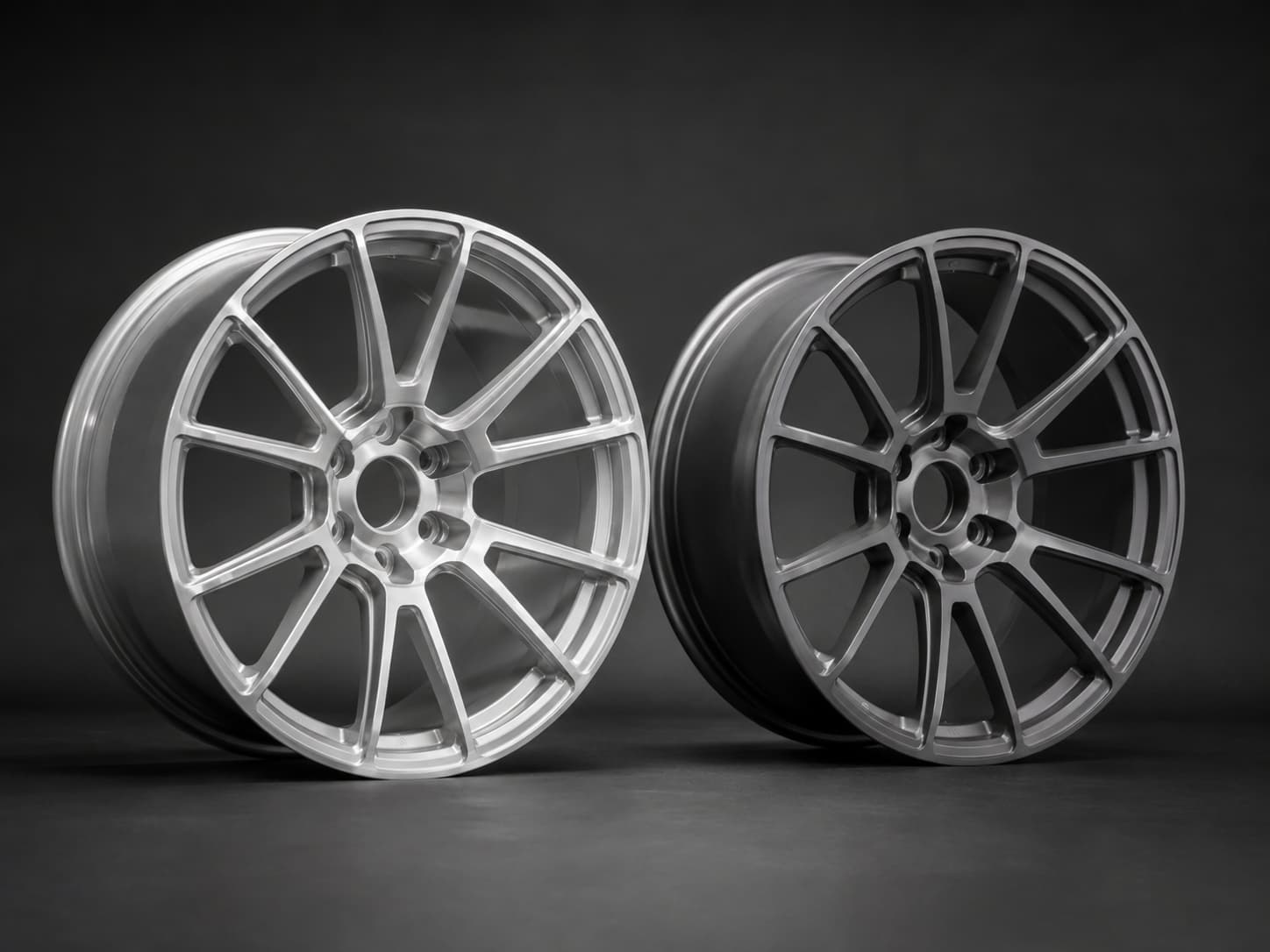
6061-T6 aluminum is the correct material for almost every street, OEM-replacement and distributor stocking program, while magnesium forged wheels in AZ80 or ZK60 are a specialist choice for motorsport and weight-critical builds where a shorter service life, a mandatory coating regime and a higher price are acceptable trade-offs. Magnesium is roughly one third less dense than aluminum, but it is also less stiff, more sensitive to corrosion and heat, and harder to homologate for road use in most markets. This guide compares the three alloys we forge — 6061-T6, AZ80 and ZK60 — on the properties that actually decide a wholesale order.
The Short Answer (TL;DR)
- 6061-T6 aluminum: density ~2.70 g/cm³, high corrosion resistance, excellent fatigue behaviour in real road conditions, refinishable, easy to certify, lower cost. The default for road wheels.
- Magnesium forged wheels (AZ80 / ZK60): density ~1.80–1.83 g/cm³, best strength-to-weight and vibration damping, but lower elastic modulus, lower service temperature, mandatory multi-layer coating, higher billet cost and more restricted road homologation.
- Weight saving is real but smaller than the density gap suggests — a magnesium wheel usually needs thicker sections to recover stiffness, so the finished-part saving is design-dependent, not a flat 33%.
- Commercial reality: for wholesale and distributor programs, aluminum sells volume; magnesium forged wheels sell to a narrow, high-margin track and show segment.
- FLEXIFORGED forges both in-house in Chongqing on 60+ CNC machines (3/4/5-axis), MOQ 4 pcs per design, mixed sizes allowed.
What Each Alloy Actually Is
6061-T6 aluminum
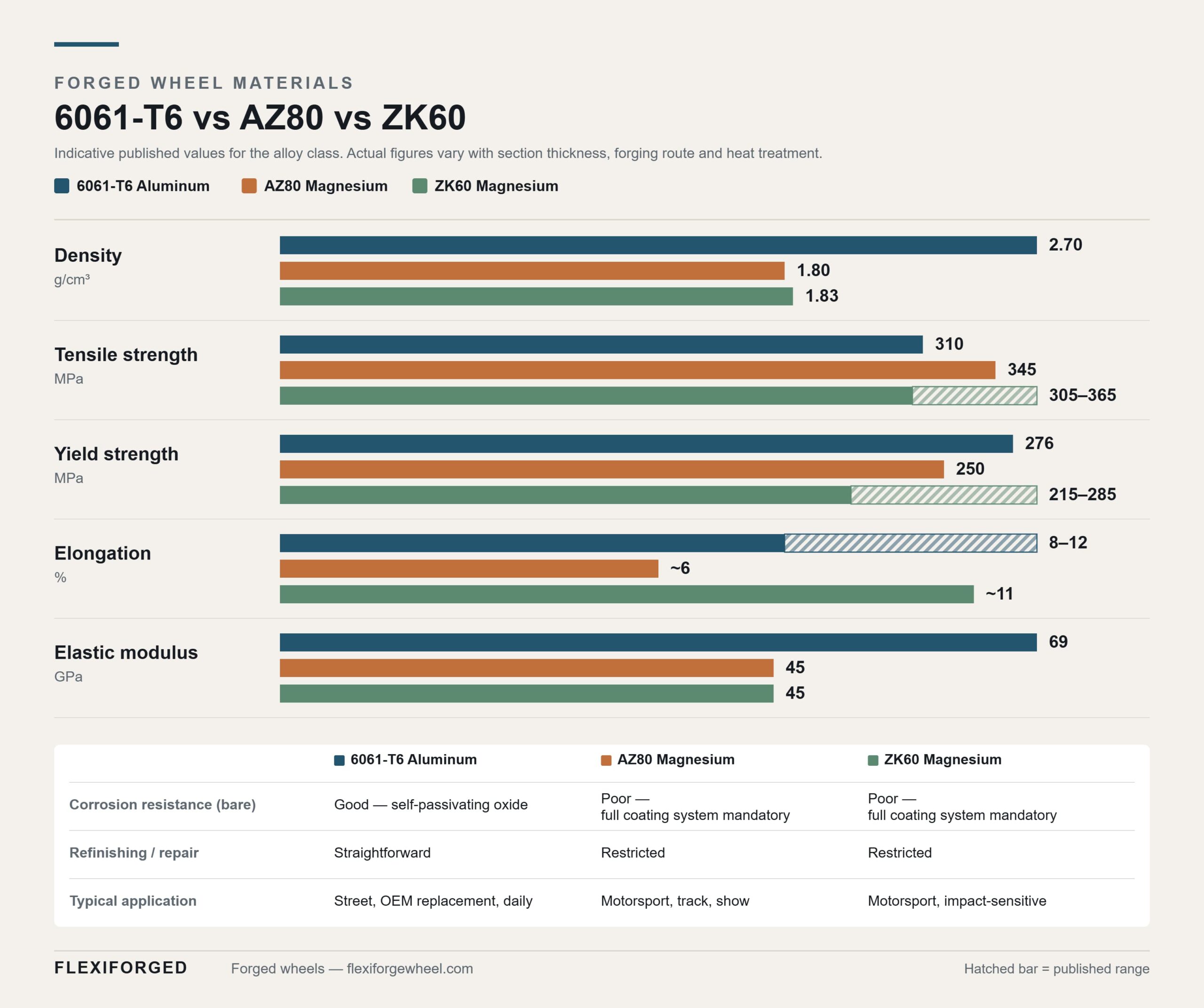
6061 is a magnesium-silicon aluminum alloy; the T6 suffix means it has been solution heat-treated and artificially aged. In a forged wheel the grain flow follows the spoke and barrel geometry, which is what gives a forged 6061-T6 wheel its fatigue advantage over a cast wheel of the same weight. Typical published values are around 310 MPa tensile strength, 276 MPa yield and 8–12% elongation, with an elastic modulus near 69 GPa. It anodises and powder-coats readily, it can be diamond-cut and refinished, and its natural oxide layer makes it forgiving about salt, brake dust and rain.
AZ80 magnesium
AZ80 is a magnesium-aluminum-zinc alloy (roughly 8% Al, 0.5% Zn). Forged and aged to T5 it typically reaches around 345 MPa tensile and 250 MPa yield with modest elongation near 6%. It is the more common forged magnesium wheel alloy and the more economical of the two.
ZK60 magnesium
ZK60 is a magnesium-zinc-zirconium alloy (roughly 5.5% Zn with a zirconium grain refiner). The zirconium produces a finer grain structure, giving better ductility — typically 305–365 MPa tensile with elongation around 11% — which is why ZK60 is often specified where impact tolerance matters more than raw cost.
6061-T6 vs Magnesium Forged Wheels: Property Comparison
| Property | 6061-T6 Aluminum | AZ80 Magnesium | ZK60 Magnesium |
|---|---|---|---|
| Density | ~2.70 g/cm³ | ~1.80 g/cm³ | ~1.83 g/cm³ |
| Tensile strength (forged, aged) | ~310 MPa | ~345 MPa | ~305–365 MPa |
| Yield strength | ~276 MPa | ~250 MPa | ~215–285 MPa |
| Elongation | ~8–12% | ~6% | ~11% |
| Elastic modulus (stiffness) | ~69 GPa | ~45 GPa | ~45 GPa |
| Thermal conductivity | ~167 W/m·K | Lower (~80 W/m·K class) | Lower (~120 W/m·K class) |
| Corrosion resistance (bare) | Good | Poor — coating mandatory | Poor — coating mandatory |
| Vibration damping | Moderate | High | High |
| Refinishing / repair | Straightforward | Restricted | Restricted |
| Relative billet cost | Baseline | Substantially higher | Highest |
| Typical use | Street, OEM replacement, daily | Motorsport, track, show | Motorsport, impact-sensitive |
Values are indicative published ranges for the alloy class and vary with section thickness, forging route and heat treatment — see the ASM datasheet for 6061-T6 for the aluminum baseline. Ask for the mill certificate and the finished-part test data for the specific design you are quoting.
What the Material Actually Changes
1. Weight and unsprung mass
Magnesium alloys are about 33% less dense than 6061-T6. That is the headline number, but it is not the finished-wheel number. Because magnesium’s elastic modulus is roughly 45 GPa against aluminum’s 69 GPa, a magnesium wheel deflects more for the same section. Engineers recover that stiffness by thickening spokes and the barrel, which gives some of the weight back. The realised saving therefore depends entirely on the design — on diameter, width, spoke count and load rating — which is why we publish per-design weights rather than a blanket percentage.
2. Corrosion and the coating system
This is the single biggest difference in the field, and the main reason magnesium forged wheels need more after-sales explanation than aluminum ones. Magnesium sits low on the galvanic series, so bare magnesium in contact with steel lug bolts, a steel hub face or road salt will corrode quickly. Magnesium wheels require a complete coating system — conversion coating, primer, topcoat and clear — and the coating has to remain intact. A stone chip that reaches bare metal is a service issue on a magnesium wheel and a cosmetic issue on an aluminum one. Aluminum’s own oxide layer plus a standard powder or anodised finish is far more tolerant of neglect, which matters when the end user is a retail customer rather than a race team.
3. Heat
Brake heat soak reaches the wheel. Magnesium alloys lose strength at elevated temperature faster than aluminum and have a lower practical service ceiling, so sustained heat soak needs to be engineered for — big-brake conversions, heavy vehicles and towing applications all push in the wrong direction for magnesium. Aluminum’s higher thermal conductivity also spreads the heat more evenly.
4. Repair, refinish and resale
An aluminum wheel can be stripped, re-machined lightly and refinished through normal channels. A magnesium wheel should not be casually stripped, because removing the coating exposes bare metal, and welding or straightening magnesium is specialist work. Distributors should assume magnesium forged wheels are effectively non-repairable in the retail channel and price the warranty conversation accordingly.
5. Cost and manufacturing
Magnesium billet costs materially more than 6061, the forging temperature window is narrower, scrap risk is higher, and machining magnesium generates chips that are flammable and require dedicated handling and extraction. That is a real capability question to put to any supplier of magnesium forged wheels: a factory that machines magnesium safely has invested in it, and a trading company simply cannot answer the question. The finishing line adds further cost because the coating stack is longer than for aluminum.
Standards and Certification: Mandatory vs Optional
Certification is where a lot of magnesium forged wheels projects stall, so scope the approval route before you commit to tooling.
| Item | 6061-T6 Aluminum | Magnesium (AZ80 / ZK60) |
|---|---|---|
| Factory quality system | ISO / IATF — mandatory for serious B2B supply | ISO / IATF — same requirement |
| Third-party wheel testing (TÜV / SGS) | Available on request; widely accepted | Available on request; scope and cost usually higher |
| Road homologation in your market | Normal route, well-established | Restricted in many markets — verify before ordering |
| Typical positioning | Road legal supply | Track / competition / off-road use in most cases |
| Customs classification | HS 8708.70 | HS 8708.70 |
Requirements differ by country and by vehicle category, and they change. Confirm the current rule for your destination market with your own homologation consultant or approval body before you place a magnesium order — we will supply the test data and documentation the process needs, but the market-side approval is a local determination.
How FLEXIFORGED Handles Material Selection
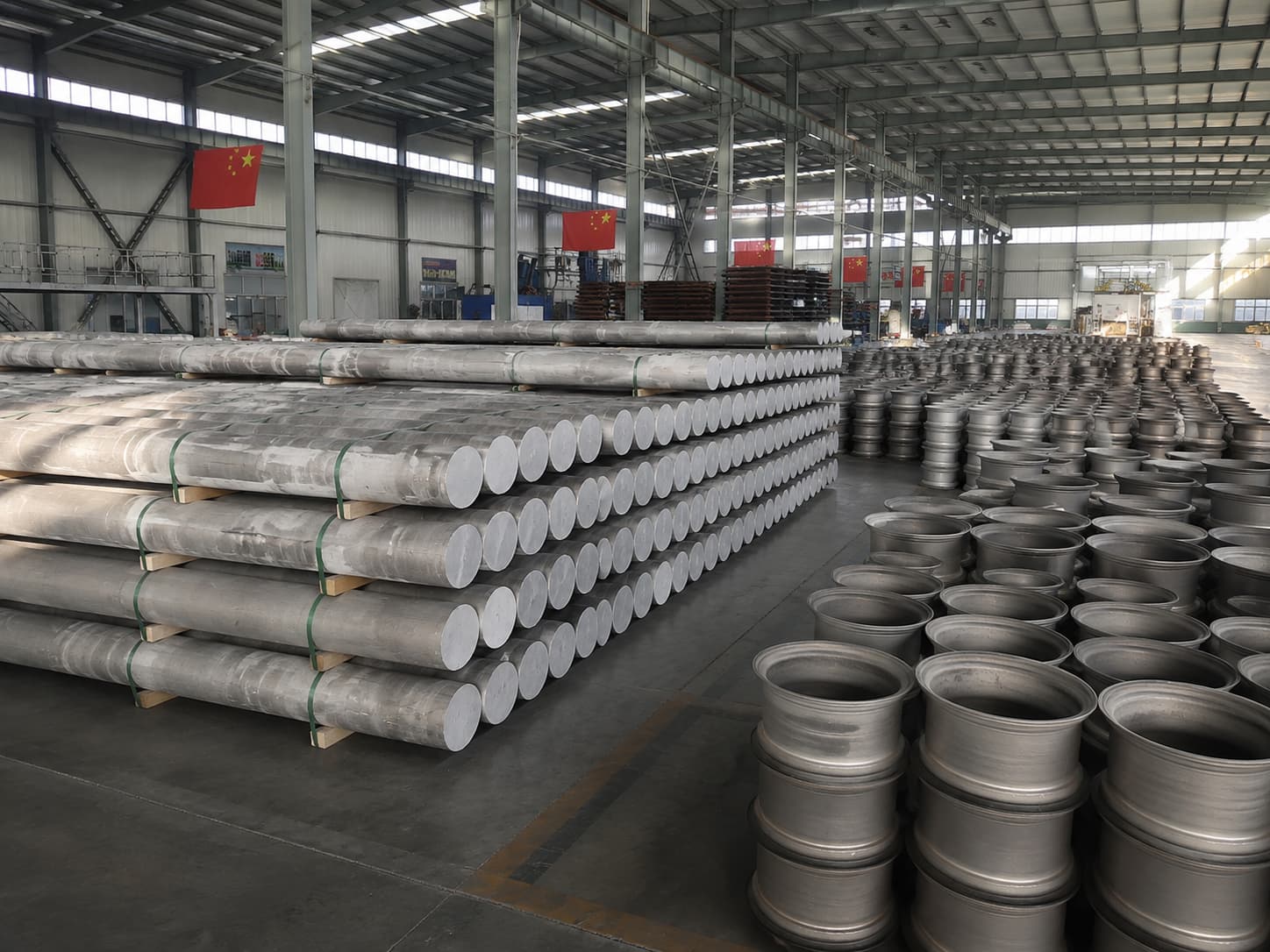
We forge both aluminum and magnesium forged wheels in-house in Chongqing, China — established 2017, 60+ CNC machines across 3, 4 and 5-axis, with forging and finish machining under one roof rather than brokered out. That matters for this specific question because material choice changes the process, not just the purchase order.
- Default recommendation: 6061-T6 for any program that will be sold to road users. It is the lower-risk, lower-cost, easier-to-certify answer, and it is what the volume of our forged monoblock wheels is built from.
- Magnesium on scope: magnesium forged wheels in AZ80 and ZK60 are handled as engineered projects. Send the application, load rating, brake package and intended use, and we scope it — see forged magnesium wheels.
- Documentation: mill certificates for the billet, dimensional reports, and third-party TÜV/SGS testing arranged on request.
- Commercial terms: MOQ 4 pcs per design with mixed sizes allowed, HS 8708.70, EXW/FOB/CIF, shipping to EU, North America, Australia and South Africa.
Should You Stock Magnesium Forged Wheels?
| If your buyer is… | Specify | Why |
|---|---|---|
| A retail distributor selling street wheels | 6061-T6 | Warranty exposure, refinishability and homologation all favour aluminum |
| An OEM-replacement or fleet account | 6061-T6 | Certification route is established; repairable in the field |
| A tuning shop building show cars | 6061-T6 | Finish range is wider and the cost supports volume |
| A race team or time-attack program | Magnesium forged wheels, AZ80 or ZK60 | Lowest rotating mass; service life is a managed variable |
| A hillclimb / rally program with impact risk | ZK60 | Better ductility than AZ80 at similar strength |
| Anything towing, heavy or brake-heat intensive | 6061-T6 | Magnesium’s temperature behaviour works against you |
The short version: stock aluminum, quote magnesium forged wheels to order. If you are still deciding on construction as well as material, start from the custom forged wheels hub and send us the vehicle and load case together.
Frequently Asked Questions
Are magnesium forged wheels road legal?
It depends entirely on your market and vehicle category. In many countries magnesium forged wheels are supplied for track, competition or off-road use rather than general road registration, and the approval route is more restricted than for aluminum. Confirm the current requirement with your local approval body before ordering. We supply the material certificates and can arrange third-party TÜV or SGS testing on request, but the market-side homologation decision is made locally.
How much lighter is a magnesium wheel than a 6061-T6 wheel?
Magnesium alloys are about 33% less dense than 6061-T6, but the finished wheel is not 33% lighter. Magnesium’s elastic modulus is roughly 45 GPa against aluminum’s 69 GPa, so sections are usually thickened to recover stiffness, which returns some of the weight. The real saving depends on diameter, width, spoke design and load rating, so we quote the actual weight of the specific design rather than a percentage.
Do magnesium forged wheels corrode?
Yes, if the coating is breached. Magnesium forged wheels are galvanically active, so bare metal in contact with steel fasteners, a steel hub face or road salt will corrode. They need a complete coating system and the coating has to stay intact — a deep stone chip is a service item rather than a cosmetic one. Aluminum’s oxide layer plus a standard powder or anodised finish is much more tolerant.
Which material do you recommend for a distributor stocking program?
6061-T6 aluminum for the stocked range, and magnesium only as a made-to-order specialist line. Aluminum carries lower warranty exposure, is refinishable through normal channels, has an established certification route and supports the price point that moves volume. Magnesium sells to a narrow track and show segment at higher margin but with more after-sales explanation required.
What’s your MOQ and lead time?
MOQ is 4 pcs per design with mixed sizes allowed. Samples are 10–15 calendar days; production is 25–30 calendar days for monoblock and 35–40 calendar days for 2-piece, counted from drawing approval. For magnesium, confirm current billet availability with us at RFQ stage, since that can affect scheduling.
Can you supply material certificates for the billet?
Yes. We provide mill certificates for the 6061-T6, AZ80 or ZK60 billet used on your order, along with dimensional reports. Third-party TÜV or SGS testing can be arranged on request. We forge and machine in-house in Chongqing rather than brokering production out, so the material traceability chain stays short.
Send Us Your Spec
Tell us the vehicle, the load case and the intended use, and we will tell you which material actually fits — including when magnesium forged wheels are the wrong answer. Email Jackie Wei, Co-Founder, at jackie.wei@flexiforged.com.
Include in your RFQ: Size × Width / PCD / ET / Quantity / Destination port / Email.