Resources / Fitment Guide
Wheel Fitment Guide: PCD, Offset and Center Bore
This wheel fitment guide shows you how to measure the four numbers every custom forged wheel order depends on — bolt pattern (PCD), offset (ET), hub center bore (CB) and width. Get them right and FLEXIFORGED machines the wheel to your hub, not to a catalog. MOQ is 4 pcs.
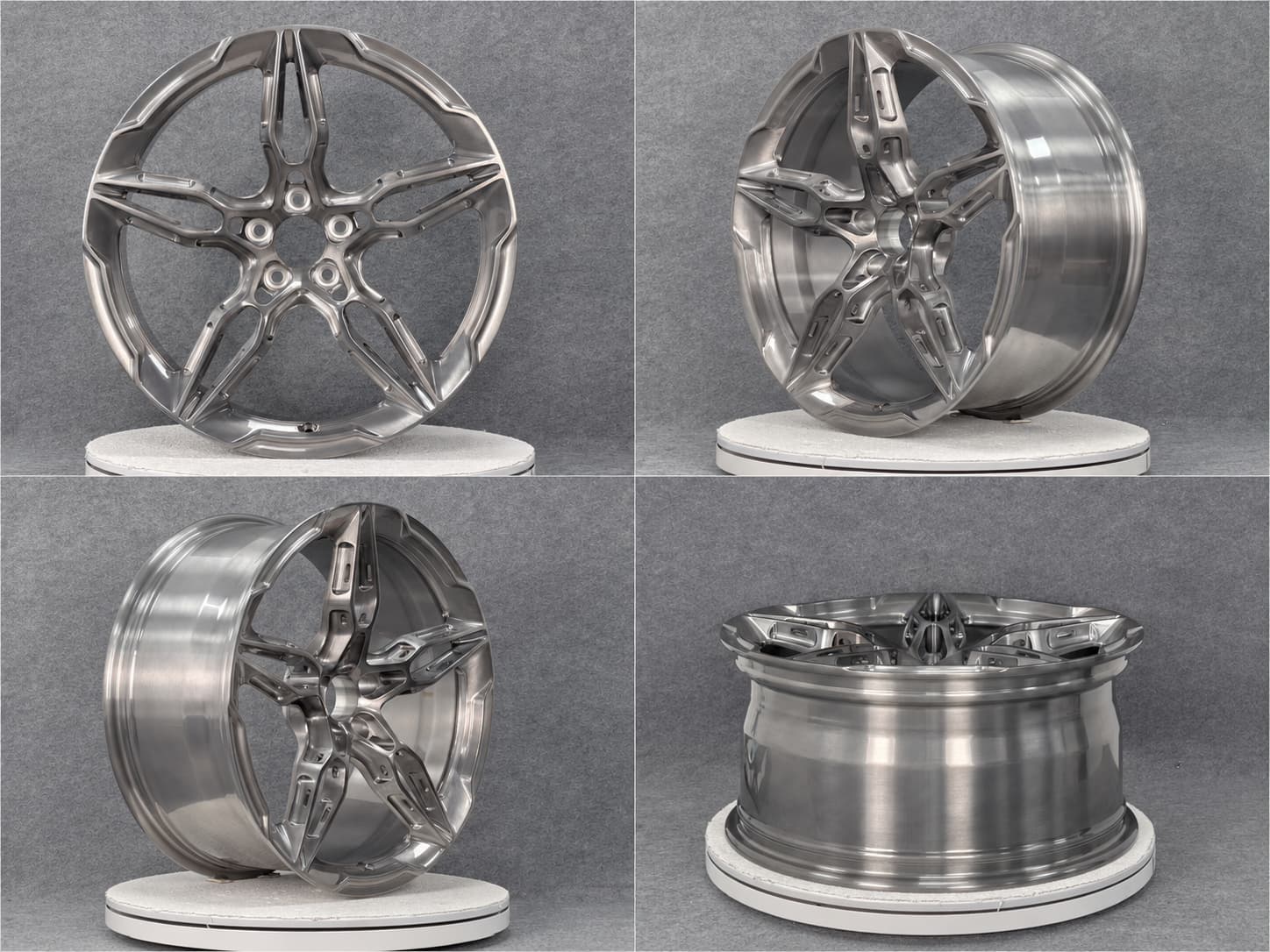
- 60+ CNC machines (3–5 axis)
- ISO & IATF 16949
- 6061-T6 aerospace aluminum
- MOQ from 4 pcs
- Worldwide export
What is wheel fitment?
Wheel fitment is the set of dimensions that decides whether a wheel bolts to your hub and clears your brakes, suspension and bodywork: bolt pattern (PCD), offset (ET), hub center bore (CB), diameter and width. A wheel with the right diameter but the wrong offset will still rub. With off-the-shelf wheels you hunt for the closest match. With forged-to-order wheels you specify the numbers, and the wheel is cut to them — key dimensions held to ±0.05 mm.
Everything below is the same checklist our engineers work from when they price an order. Fill it in and you have a quotable spec sheet.
| Spec | Notation example | Where to find it | Why it matters |
|---|---|---|---|
| Diameter × Width | 19 × 9.5J | Existing wheel face or barrel stamp | Sets tire choice and arch clearance |
| Bolt pattern (PCD) | 5×114.3 | Measure the hub studs (see below) | Wrong PCD = the wheel will not mount |
| Offset (ET) | ET35 | Stamped inside the spokes or barrel | Controls inboard and fender clearance |
| Center bore (CB) | 66.6 mm | Measure the raised hub spigot | Carries the load; wrong CB = vibration |
| Quantity | 4 pcs (1 set) | Your order | MOQ is 4 pcs; mixed sizes accepted |
| Finish | Satin black powder coat | Your spec | Adds ~5 working days if complex |
Staggered setups: list front and rear as two separate lines. A 19×9.5 ET35 front and 19×11 ET25 rear is one order, not two — mixed sizes in a single order are accepted at the 4 pcs MOQ.
How do you measure bolt pattern (PCD)?
PCD, or pitch circle diameter, is the diameter of the imaginary circle drawn through the center of every stud, written as number of studs × diameter in mm. So 5×114.3 means five studs on a 114.3 mm circle. Even-lug patterns are easy — measure straight across. Five-lug patterns have no stud directly opposite, which is where most measuring errors come from.
| Lug count | What to measure | Formula | Worked example |
|---|---|---|---|
| 4 lug | Center of one stud to center of the opposite stud | PCD = measured distance | 100 mm → 4×100 |
| 5 lug | Center of one stud to center of an adjacent stud (S) | PCD = S ÷ 0.5878 | 67.2 mm ÷ 0.5878 → 5×114.3 |
| 6 lug | Center of one stud to center of the opposite stud | PCD = measured distance | 139.7 mm → 6×139.7 |
| 8 lug | Center of one stud to center of the opposite stud | PCD = measured distance | 165.1 mm → 8×165.1 |
The general form, for any stud count n, is:
PCD = S ÷ sin(180° ÷ n) → 5 lug: sin 36° = 0.5878
| Metric | Imperial (≈) | Metric | Imperial (≈) |
|---|---|---|---|
| 4×100 | 4×3.94" | 5×120 | 5×4.72" |
| 4×10⁸ | 4×4.25" | 5×127 | 5×5.00" |
| 5×100 | 5×3.94" | 5×130 | 5×5.12" |
| 5×112 | 5×4.41" | 5×139.7 | 5×5.50" |
| 5×114.3 | 5×4.50" | 6×139.7 | 6×5.50" |
Patterns that look close are not interchangeable: 5×112 and 5×114.3 differ by 2.3 mm, enough to load the studs in shear and crack a wheel. If your hub PCD and your wheel PCD genuinely differ, the fix is a machined wheel adapter, not force. FLEXIFORGED drills your PCD directly into the wheel, so an adapter is rarely needed on a custom order.
What does ET (offset) mean, and how do you choose it?
Offset, marked ET, is the distance in millimetres from the wheel's mounting face to the centerline of the rim. Positive ET puts the mounting face outboard of the centerline and pulls the wheel in toward the suspension. Negative ET pushes it out toward the fender. Zero ET means the mounting face sits exactly on the centerline. Every 1 mm of ET change moves the wheel 1 mm sideways — the single most useful number in this guide.
| Change | Wheel moves | Gains | Risks |
|---|---|---|---|
| ET increases (e.g. ET35 → ET45) | 10 mm inboard | More fender clearance, tucked look | Strut, spring, brake caliper and inner arch fouling |
| ET decreases (e.g. ET35 → ET25) | 10 mm outboard | More caliper clearance, wider stance | Fender rub, more scrub radius, higher bearing load |
| Width +1" at same ET | 12.7 mm each way | More tire section | Rubs at both ends simultaneously |
Converting offset to backspacing
North American shops often work in backspacing — the distance from the mounting face to the inner rim flange. The two describe the same thing:
Backspacing (in) = (Rim width in inches + 1) ÷ 2 + ET ÷ 25.4
A 9.5" wide wheel at ET35: (9.5 + 1) ÷ 2 + 1.38 = 6.63" of backspacing. The +1" allows for the two rim flanges outside the quoted bead-seat width. Send us either figure — state which one you used and we convert it.
Because a 2-piece forged wheel assembles a machined center to a barrel, offset can be dialled in during assembly; a monoblock has its offset cut into the billet. Both are made to your ET — the difference is how the number is reached.
Coilovers, big brakes, wide-body? Stock ET is no longer your ET. Tell us what is fitted and what you measured, not what the factory wheel says. We do not publish a fixed ET range, because offset is engineered to your car rather than picked off a shelf: send the measurements and the modifications, and we assess a workable ET and put it on your drawing for approval.
What is center bore, and do you need spigot rings?
The center bore is the machined hole in the back of the wheel that sits over the raised spigot on your hub. When the bore matches the hub, the hub carries the vehicle's weight and the bolts only clamp — that is a hub-centric fit. When the bore is oversized, the bolts carry the load and the wheel is centered by whatever the fitter can manage, which is how steering-wheel vibration at 100 km/h starts.
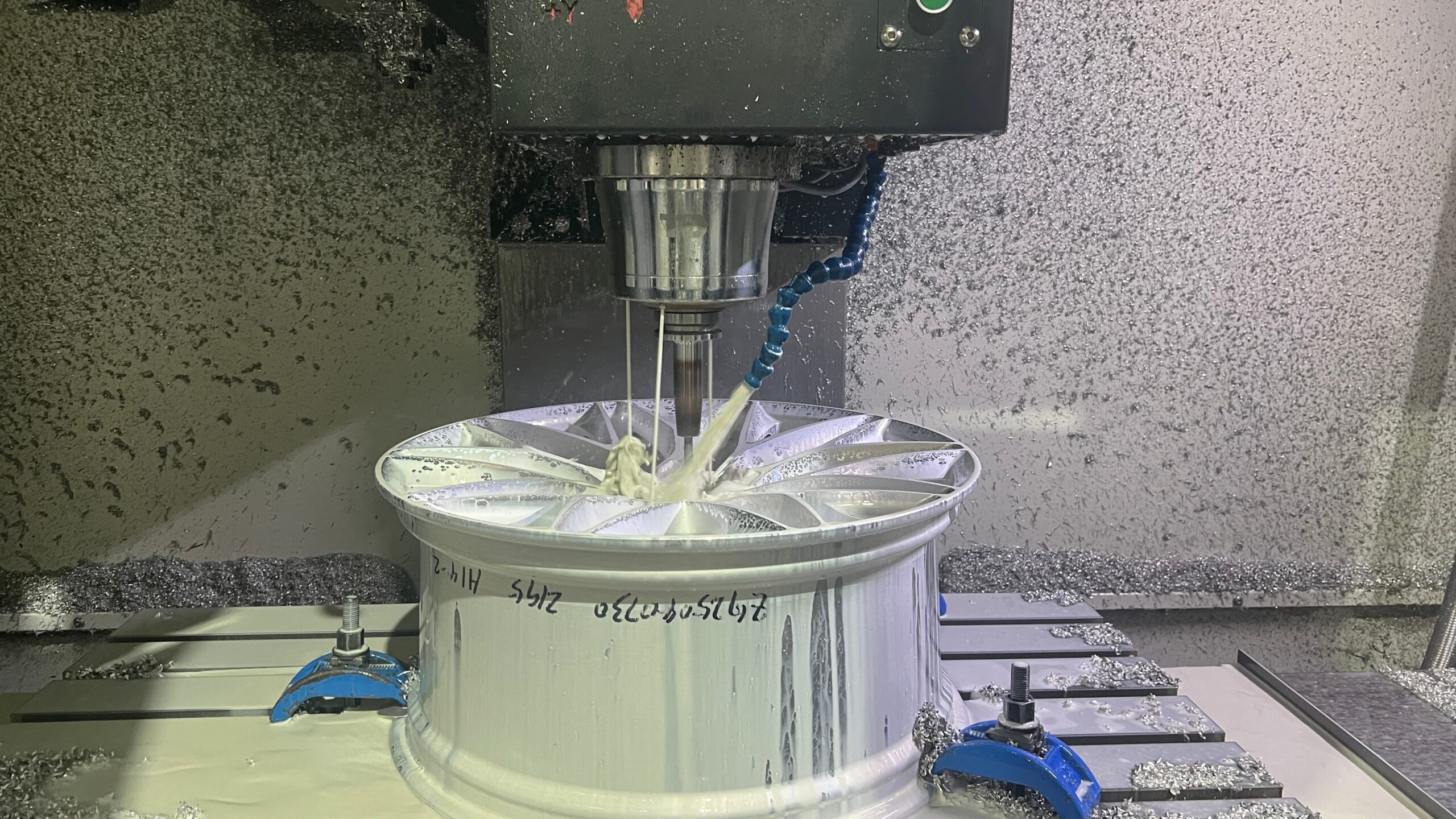
Mass-produced wheels ship with a large universal bore plus plastic spigot rings to fill the gap. FLEXIFORGED does not work that way: every wheel is CNC-machined to order, so the bore is cut to your hub diameter, held to ±0.05 mm on key dimensions and 100% runout tested to under 0.01". No rings, no shims, no filler.
Measure the outside diameter of the hub spigot with a caliper, in millimetres, to one decimal place. If you cannot reach it, give us the vehicle and the wheel you are running now and note the bore of that wheel.
How do you choose diameter, width and tire size?
Diameter and width set the tire, and the tire sets the clearance. Quote width in inches at the bead seat — the "J" in 9.5J is the flange profile, not the width. Then tell us three things that override every catalog table:
Brake package
Caliper size and rotor diameter decide minimum spoke clearance and the lowest usable ET. Photos of the caliper on the hub help more than a part number.
Suspension state
Ride height, camber, and whether coilovers or air are fitted change what clears at full lock and full compression, not just parked.
Bodywork & use
Stock arches, rolled, or wide-body — plus street, track, drift or off-road. Load rating for passenger and performance wheels runs ~690–955 kg; off-road builds run higher.
| Parameter | Range we build | Notes |
|---|---|---|
| Diameter | 15" – 26" | Combined range across monoblock, 2-piece and 3-piece construction |
| Width | 5" – 16" | Quoted at the bead seat; the "J" is the flange profile, not the width |
| Offset (ET) | Engineered to the vehicle | No fixed catalog range — assessed from your measurements and confirmed on the drawing |
| Center bore | Machined to your hub | Key dimensions held to ±0.05 mm; no spigot rings |
Not every diameter and width pairs with every design — the combination is confirmed on your drawing before anything is cut. If your target sits at the edge of the envelope, send it anyway and we will tell you straight whether it is buildable.
How do you send fitment specs to FLEXIFORGED?
Five steps, about 30 minutes with a caliper. You do not need a CAD file or a wheel designer — you need numbers.
-
Measure the bolt pattern
Count the studs and apply the formula above. Write it as 5×114.3, not "five lug".
-
Measure the hub center bore
Outside diameter of the hub spigot, in mm, to one decimal. We machine the wheel bore to match.
-
Decide the offset per axle
Give ET in mm (or backspacing in inches, stated as such), separately for front and rear.
-
Set diameter, width, tire and finish
Inches per axle, planned tire size, and the finish: powder coat, brushed, polished, anodized, chrome or custom two-tone.
-
Send it with your quantity and destination port
Use the quote form or WhatsApp. We reply with pricing and a drawing showing size, offset, center bore and load rating. Nothing is cut until you approve that drawing. Every produced wheel is then engraved with its size, offset, center bore, load rating and serial number, backed by a QC record with photos or video on request. Samples take 10–15 working days; production 20–30 working days.
What are the most common fitment mistakes?
These six account for nearly every "the wheels don't fit" message we receive. All are avoidable before the order is placed.
| Mistake | What goes wrong | The fix |
|---|---|---|
| Measuring 5-lug PCD across adjacent studs | You report 67.2 instead of 114.3 | Divide the adjacent measurement by 0.5878 |
| Quoting the OEM ET after a big brake kit or coilovers | Wheel fouls the caliper or the strut | Measure the car as it is now, and tell us the mods |
| Treating 5×112 and 5×114.3 as the same | Studs loaded in shear; cracking risk | Confirm the PCD to one decimal before ordering |
| Oversized bore "fixed" with spigot rings | Vibration, bolt fatigue | Give us the hub diameter — we machine the bore to it |
| Sending one spec line for a staggered set | Rears built to front width or offset | Two lines: front and rear, each with size and ET |
| Ignoring bolt seat type and thread | Cone seat bolts on ball seat wheels; loosening | State seat type and thread pitch — see wheel hardware |
Which of these are you?
Fitment questions arrive from three directions. Tell us which one you are and we route you to the right engineer.
Tuning shop / dealer
You measure customer cars weekly and need fast quotes on one-off staggered sets. MOQ 4 pcs means no stock risk. Dealer supply program →
Brand builder
You sell designs, not measurements, and need a factory that engraves your logo and signs an NDA. Private label wheels →
OEM / private-label buyer
You have drawings and tolerances already and need IATF 16949 process control against them. Custom forged wheels →
Wheel fitment FAQ
What information does FLEXIFORGED need for a fitment quote?
Six values per axle: diameter and width in inches, bolt pattern (PCD), offset (ET) in mm, hub center bore (CB) in mm, quantity, and finish. Also tell us the vehicle, the tire size, and any brake or suspension changes. MOQ is 4 pcs and mixed front and rear sizes are accepted in one order.
How do you measure PCD on a 5-lug hub?
Measure center-to-center between two adjacent studs, then divide by 0.5878. For example, 67.2 mm between adjacent studs ÷ 0.5878 = a 114.3 mm pitch circle, written 5×114.3.
What does ET mean on a wheel?
ET is the wheel offset in millimetres: the distance from the mounting face to the rim centerline. Positive ET pulls the wheel inboard, negative ET pushes it outboard, and every 1 mm of ET change moves the wheel 1 mm laterally.
Do FLEXIFORGED wheels need hub-centric spigot rings?
No. Wheels are CNC-machined to order, so the center bore is cut to your hub diameter with key dimensions held to ±0.05 mm and 100% runout testing to under 0.01". No plastic or alloy rings are required.
Can I order different fitment front and rear?
Yes. Mixed sizes, widths and offsets in one order are accepted, and MOQ is 4 pcs — one set. Each wheel is engraved with its size, offset, center bore, load rating and serial number, so a staggered set cannot be mixed up on fitting.
Do I get a drawing to approve before production starts?
Yes. Once your specs are agreed we issue a drawing showing size, offset, center bore and load rating. Production is only scheduled after you confirm that drawing, so any fitment misunderstanding is caught on paper instead of on the car.
How long does production take once fitment is confirmed?
Samples take 10–15 working days and production 20–30 working days, plus about 5 days for complex finishes or peak season. We ship EXW, FOB or CIF, with commercial invoice, packing list and HS code 8708.70.
You have the numbers. We'll cut the wheel to them.
Send your size, PCD, ET, CB, quantity, finish and destination port. You get a drawing back to approve — nothing is cut until you sign off. Forged from 6061-T6 on 60+ CNC machines under ISO and IATF 16949, from 4 pcs. Not sure about one value? Send what you have and we'll work it out with you.
FLEXIFORGED — Shapingba District, Chongqing, China · Founded 2017 · jackie.wei@flexiforged.com · +86 178 3048 5180