A forged wheel quotation only becomes comparable to another quotation once you read it as five separate cost blocks — unit price, tooling and CAD, packing, Incoterm and freight, and payment terms — because two suppliers both quoting “$310 per wheel” can differ by 20–30% in real landed cost once those blocks are counted. Most disputes between importers and Chinese wheel factories are not caused by the unit price at all. They are caused by a line item that was never on the proforma invoice in the first place.
This guide walks through a forged wheel proforma invoice (PI) field by field, explains what each line actually commits you to, and shows you which omissions should stop you from wiring a deposit.
The Short Answer (TL;DR)
- A quotation is an offer; a proforma invoice is the document you pay against. Once you transfer the deposit against a PI, its terms are what you have agreed to.
- Compare landed cost, not unit price. An EXW price and a CIF price are not the same number, and neither includes duty at your end.
- Tooling / CAD / setup is normal on custom forged wheels and should appear as its own line. A supplier who hides it has buried it in the unit price — which hurts you when you reorder.
- Every PI must state size × width, PCD, ET, centre bore, construction, finish, quantity, Incoterm, destination port, lead time, validity and HS code. Anything missing is a future argument.
- Lead time should be counted from drawing approval, not from the deposit date, and should say whether the days are calendar or working days.
Quotation vs Proforma Invoice: What’s the Difference?
A quotation is a commercial offer. It tells you a price under stated conditions and is usually valid for a fixed window (often 15–30 days, because aluminium billet is priced against LME movements).
A proforma invoice (PI) is the formal pre-shipment document you pay against. It carries the seller’s bank details, the exact goods description, the Incoterm, the payment schedule and the delivery commitment. In practice, in China–EU and China–US wheel trade, the signed and stamped PI functions as the contract for a normal repeat order. Larger buyers still sign a separate purchase agreement, but the PI is what the bank, your freight forwarder and your customs broker will all reference.
Practical rule: never wire a deposit against a quotation, a WhatsApp message or a spreadsheet. Ask for a stamped PI first.
Line by Line: What Every Field on a Forged Wheel PI Means
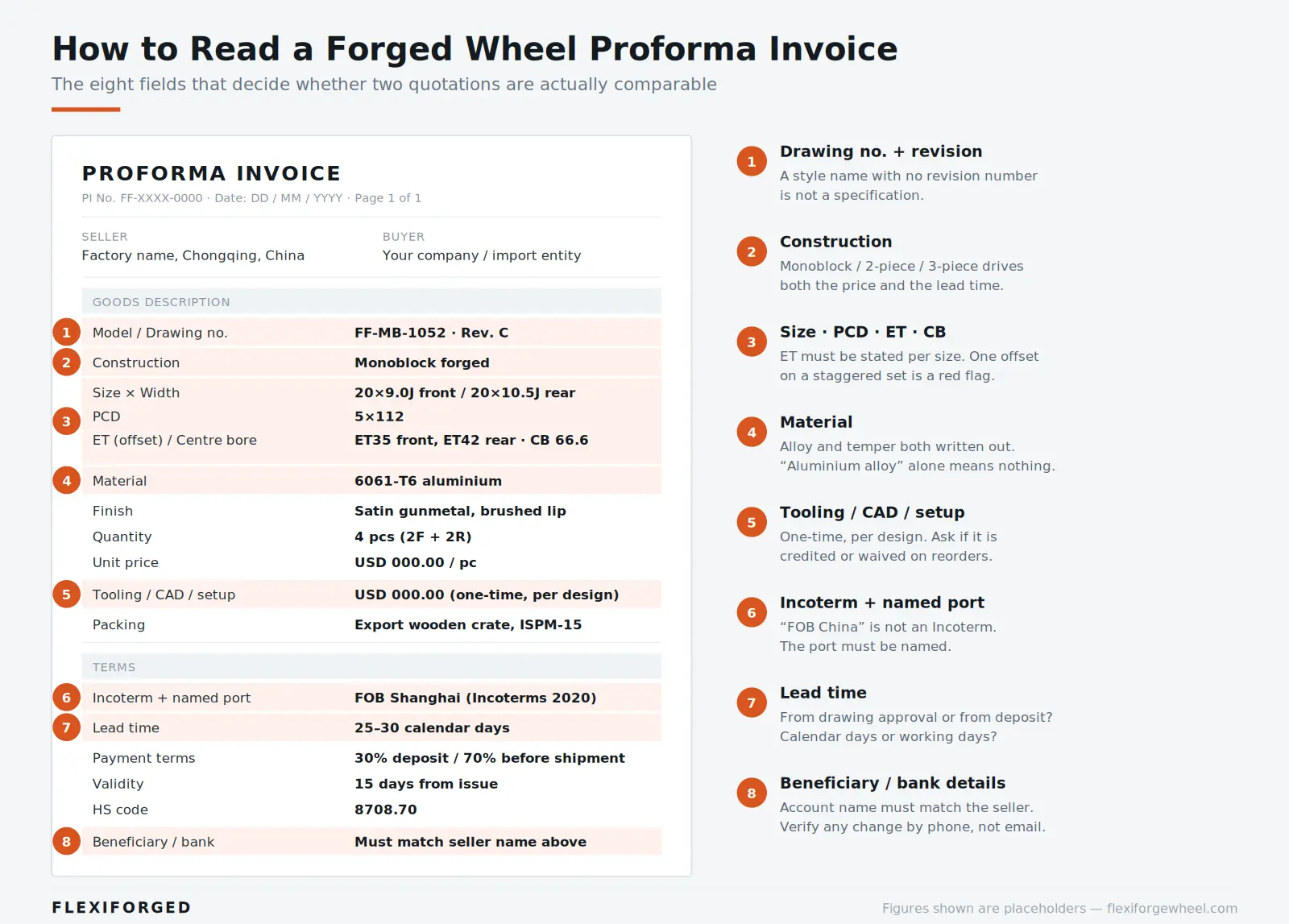
| Line item | What it means | What to check |
|---|---|---|
| Model / drawing no. / revision | Which approved CAD file the price is based on | A revision number must be present. “Style A” with no drawing reference is not a specification. |
| Construction | Monoblock, 2-piece or 3-piece | This drives both price and lead time. It should never be blank. |
| Size (diameter × width) | e.g. 20×9.0J front / 20×10.5J rear | Staggered sets must be priced per axle, not averaged. |
| PCD / bolt pattern | e.g. 5×112, 5×120 | Confirm single or dual-drilled; dual drilling may carry a small adder. |
| ET (offset) | Millimetres, per size | Must be stated per size. One ET on a staggered set is a red flag. |
| Centre bore (CB) | Hub bore in mm | Machined-to-hub vs oversize + rings changes fitment and cost. |
| Material | e.g. 6061-T6 aluminium; AZ80 / ZK60 magnesium | Alloy and temper should both be written. “Aluminium alloy” alone is meaningless. |
| Finish | Gloss / matte paint, brushed, polished lip, two-tone | Two-tone and brushed-clear cost more than single-colour. Get the code, not the word “grey”. |
| Quantity | Pieces, split by size | Check whether price breaks are per design or per total order. |
| Unit price | Price per wheel under the stated Incoterm | Meaningless without the Incoterm next to it. |
| Tooling / CAD / setup | One-time engineering and programming cost for a new design | Ask if it is waived or credited on reorders, and who owns the file. |
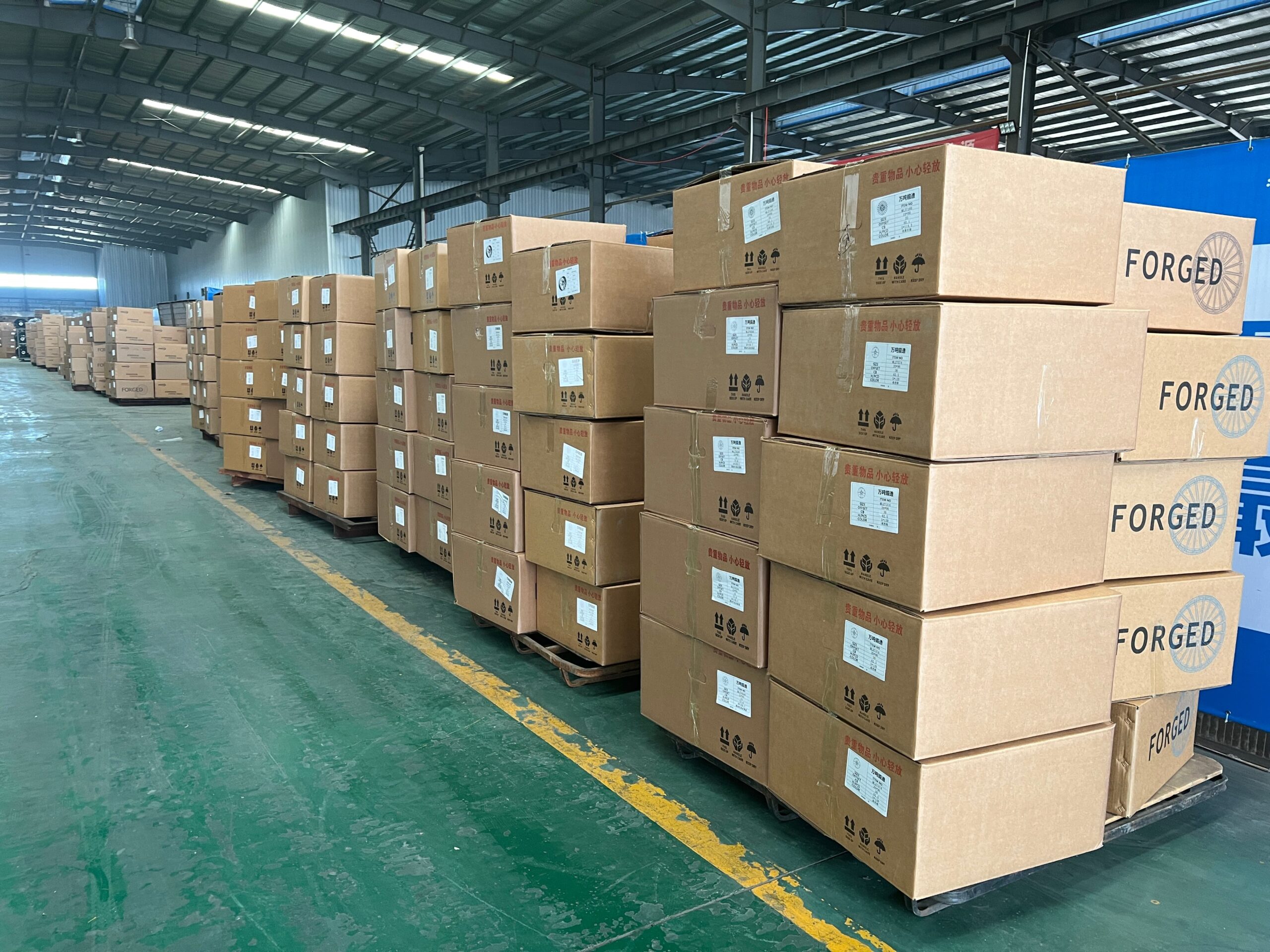
| Packing | Carton, pallet or export-grade wooden crate | Crates cost more but survive multi-leg transit. Confirm ISPM-15 treatment for EU/AU. |
| Incoterm + named port | EXW / FOB / CIF plus the port name | “FOB China” is not an Incoterm. It must name a port. |
| Lead time | Production days to ex-works readiness | From drawing approval or from deposit? Calendar or working days? Get it in writing. |
| Payment terms | e.g. 30% deposit, 70% before shipment | Define what triggers the balance: BL copy, photos, or third-party inspection pass. |
| Validity | How long the price holds | Aluminium billet is LME-linked; expect 15–30 days, not 6 months. |
| HS code | 8708.70 for road wheels and parts | Your broker needs it to pre-calculate duty. Verify against your own tariff schedule. |
| Beneficiary / bank details | Where the money goes | Company name on the PI must match the bank account name. Confirm any change by phone, never by email alone. |
Construction is the single biggest swing factor on the whole document. If you are still deciding between a one-piece and a bolted design before you request pricing, compare forged monoblock wheels against forged 2-piece wheels first — the quotation will look very different depending on which you choose.
EXW vs FOB vs CIF: Why the Same Wheel Has Three Prices
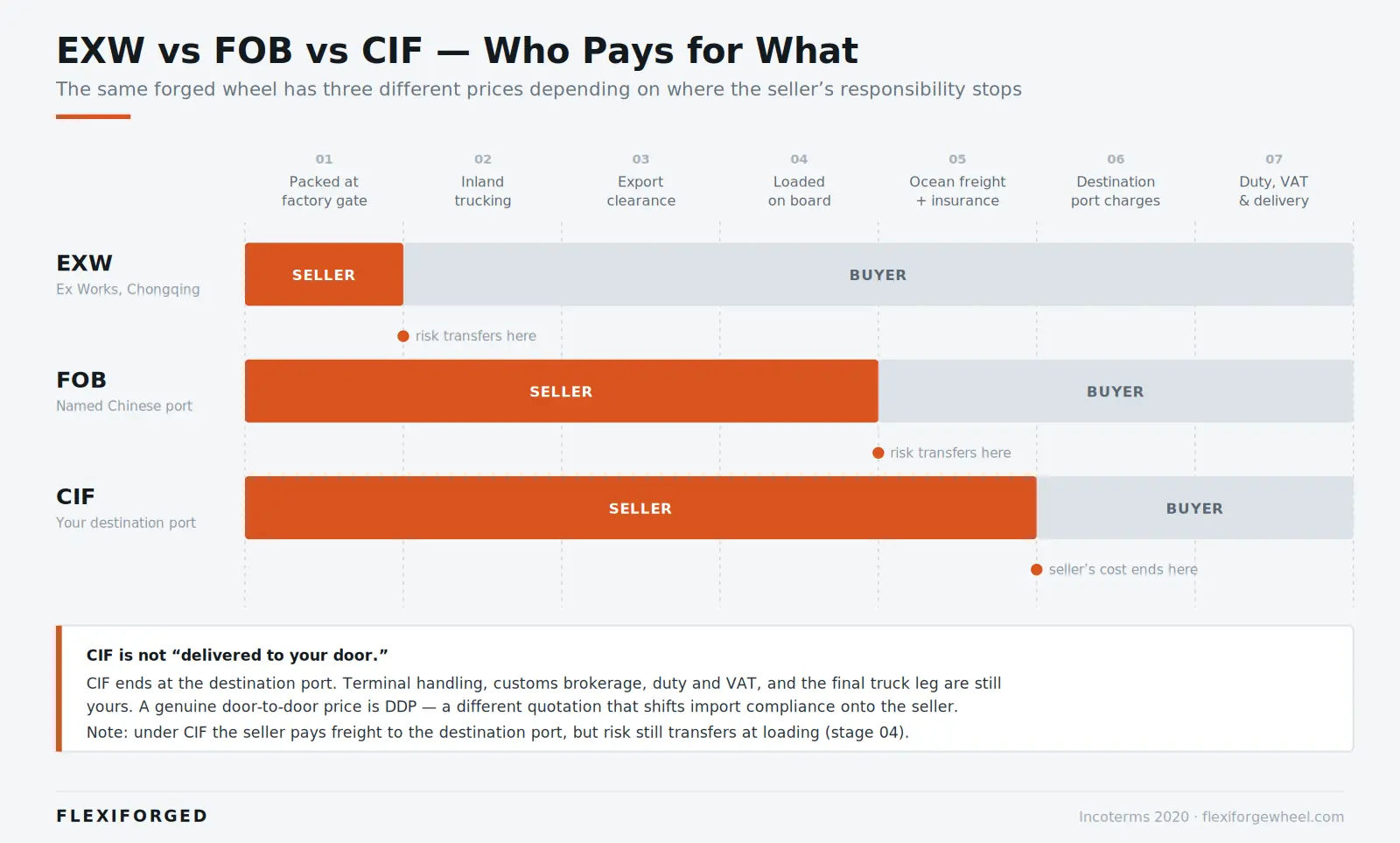
The Incoterm decides where the seller’s responsibility stops and yours begins. It is the most common reason two quotations that “look the same” are not.
| Term | Seller covers | You cover | Best for |
|---|---|---|---|
| EXW (Ex Works, Chongqing) | Goods packed and ready at the factory gate | Inland trucking, export clearance, terminal fees, ocean freight, insurance, import duty, delivery | Buyers with a China-based forwarder and consolidation from multiple suppliers |
| FOB (named Chinese port) | Inland transport, export clearance, loading on board | Ocean freight, insurance, import duty, destination charges, delivery | Most experienced importers — clean risk transfer, you control the freight rate |
| CIF (your destination port) | Everything to the destination port, incl. freight and minimum marine insurance | Destination terminal handling, customs clearance, duty/VAT, delivery to your warehouse | First-time importers and smaller orders who want one number to budget against |
The trap with CIF: buyers often read it as “delivered”. It is not. CIF ends at the destination port. Terminal handling charges, customs brokerage, duty and VAT, and the final truck leg are still yours. If you want a genuinely door-to-door number, you are asking for DDP, which is a different quotation entirely and shifts import compliance onto the seller.
Costs That Are Usually Not in the Unit Price
These are legitimate costs, not tricks — but they belong on the PI where you can see them, and a thin quotation is often thin because they have been left off.
- Tooling, CAD and CNC programming for a new custom design (one-time, per design).
- Sample cost, and whether it is credited against the production order.
- Third-party testing — TÜV or SGS reports are quoted per model, not per order, and take their own calendar time.
- Centre caps, valve stems, bolts and rings — often assumed to be included, often not.
- Custom laser engraving or private-label branding on the spoke face or barrel.
- Export-grade crating and ISPM-15 heat treatment where required.
- Destination-side costs: THC, customs brokerage, duty and VAT, demurrage if clearance stalls.
Red Flags on a Forged Wheel Quotation
- No Incoterm, or “FOB China” with no port. The price cannot be compared or budgeted.
- Lead time with no starting point. “30 days” from deposit and from drawing approval can be three weeks apart in reality.
- “Forged” with no alloy and temper stated. Ask for 6061-T6 in writing, or magnesium grade if applicable.
- Certification claims with no scope. A factory quality-system certificate is not the same as a per-model TÜV or JWL report. Ask which model the report covers and what its number is.
- Bank account name that differs from the seller on the PI. Stop and verify by phone. This is the single most common wire-fraud vector in this trade.
- No validity date. An open-ended price usually means it will be revised after you commit.
- A price far below everyone else’s. On a forged wheel it usually means flow-formed or gravity-cast product, a lighter finish spec, or a trading company that will re-quote after your deposit lands.
What to Send Us So the Quotation Comes Back Accurate
The faster route to a firm price is giving the factory everything it needs in one message. For each design:
- Construction — monoblock, 2-piece, or “please advise”.
- Size × width per axle (e.g. 19×8.5J front, 19×9.5J rear).
- PCD and whether dual-drilling is needed.
- ET (offset) per size, and centre bore.
- Finish — colour code or reference photo, single or two-tone.
- Quantity per size, plus your expected annual volume if you want tiered pricing.
- Destination port and preferred Incoterm.
- Certification needs — TÜV, JWL/VIA, or none, depending on your market.
- Design reference — your CAD, a sketch, or a photo of the style you want matched.
How FLEXIFORGED Quotes
We are a factory in Chongqing, China, established in 2017, running 60+ CNC machines (3-, 4- and 5-axis) with in-house forging and finish machining — not a trading company reselling someone else’s output. That matters on a quotation because the cost lines you see are ours, not a layer of margin over another supplier’s PI.
| PI line | FLEXIFORGED standard |
|---|---|
| MOQ | 4 pieces per design; mixed sizes permitted within a set |
| Material | 6061-T6 aluminium; AZ80 / ZK60 magnesium on request |
| Lead time (calendar days from drawing approval) | Samples 10–15 · Monoblock 25–30 · 2-Piece 35–40 · 3-Piece 40–45 |
| Certification | ISO and IATF certified factory; third-party TÜV / SGS testing available on request, quoted per model |
| Incoterms | EXW / FOB / CIF, always with the named port on the PI |
| HS code | 8708.70 (verify against your own national tariff schedule) |
| Markets served | EU, North America, Australia, South Africa |
Tooling and CAD appear as their own line on every PI we issue, so you can see exactly what a reorder of the same design will and will not cost you.
FAQ
Is a proforma invoice the same as a contract?
In practice, yes, for a normal repeat order. Once you sign or stamp the PI and send the deposit, its terms are what both sides have agreed to. For large or first-time orders, many buyers still sign a separate purchase agreement covering warranty, defect handling and dispute resolution, with the PI attached as the commercial schedule.
Why is tooling charged separately when the wheel already has a unit price?
Tooling, CAD work and CNC programming are one-time engineering costs for a specific design, not per-wheel costs. Showing them separately keeps the unit price honest and lets you see what a reorder of the same design will cost once that work is already done. A supplier who folds tooling into the unit price is charging you for it again on every reorder.
Should I ask for EXW, FOB or CIF?
If you already work with a freight forwarder, FOB gives you a clean risk transfer at the Chinese port and lets you control the ocean freight rate. If this is your first import or the order is small, CIF is easier to budget because freight and marine insurance are included. Remember that CIF ends at the destination port — terminal handling, customs clearance, duty and the final delivery leg are still yours.
What’s your MOQ, and does the unit price change with quantity?
Our MOQ is 4 pieces per design, and mixed sizes are permitted within a set. Unit price does move with volume, mainly because tooling and setup are amortised over more pieces and because material can be batched more efficiently. Tell us your expected annual volume and we will quote tiered pricing rather than a single number.
How long is a forged wheel quotation valid?
Expect 15 to 30 days. Forged wheel pricing is tied to aluminium billet, which moves with LME pricing, and to freight rates that can shift week to week. A quotation with no validity date should be treated as incomplete, not as a long-term price guarantee.
Does your lead time start from the deposit or from drawing approval?
From drawing approval. Our figures are calendar days from that point: 10–15 for samples, 25–30 for monoblock, 35–40 for 2-piece, and 40–45 for 3-piece. Counting from the deposit is misleading because the drawing revision cycle sits between the two, and that cycle depends on how quickly both sides sign off.
Get a Quotation You Can Actually Compare
Send us your specification and we will return a proforma invoice with every line itemised — unit price, tooling, packing, Incoterm and lead time — so you can put it side by side with any other supplier’s. Browse custom forged wheels to see what we build, then email jackie.wei@flexiforged.com.
To get a firm quote, send us:
- Size × Width
- PCD
- ET (offset)
- Quantity
- Destination port